
How Much Does Pet Insurance Cost in 2026?

Pet insurance premiums in 2026 range from $25 to $70 per month for dogs and $15 to $40 per month for cats, depending on the animal’s breed, age, location, and the level of coverage selected. Those figures represent a wide range because the variables that drive cost are significant. A two-year-old mixed-breed dog in Mississippi will carry a very different premium than a four-year-old French Bulldog in California, and understanding why helps owners make a more informed choice when comparing plans.
According to data from the North American Pet Health Insurance Association (NAPHIA), the pet insurance market has grown substantially over the past several years, and average premiums have shifted accordingly as veterinary costs have risen and more coverage options have come to market. The average monthly premium for an accident-and-illness plan for a dog was approximately $44 per month as of the most recent industry reporting period, with cats averaging around $29 per month.
This article breaks down what actually drives pet insurance cost in 2026, with pricing data organized by breed, by state, and by coverage level, so owners can estimate what a plan is likely to cost for their specific pet before they request a quote.
Key Takeaways
- Dog insurance averages $25–$70 per month in 2026; cats average $15–$40 per month, with significant variation by breed, age, state, and coverage level.
- Breed is one of the strongest cost drivers: large breeds and brachycephalic dogs (French Bulldogs, English Bulldogs) carry some of the highest premiums due to elevated health risk.
- Location affects premiums because veterinary costs vary by region. States with higher average vet costs, such as California and New York, produce higher premiums.
- Age at enrollment matters. Premiums increase as pets get older, and pre-existing conditions are excluded, so enrolling while a pet is young and healthy provides the broadest coverage at the lowest cost.
- Accident-and-illness plans provide the most complete protection. A Wellness Plan can be added to help cover routine and preventive care costs, including exams, vaccines, and dental cleanings.
- Adjusting the deductible, reimbursement percentage, and annual limit are the main tools for balancing premium cost against out-of-pocket exposure.
In This Article
- What the Average Pet Insurance Premium Covers
- Pet Insurance Cost by Breed: Top 20 Dog Breeds
- Pet Insurance Cost by State
- How Age Affects Your Premium
- Coverage Level: What You Choose Determines What You Pay
- What Makes Premiums Go Up Over Time
- Accident-Only Plans: A Limited Option for Specific Situations
- Adding a Wellness Plan for Complete Protection
- How to Get an Accurate Quote for Your Pet
- Frequently Asked Questions
What the Average Pet Insurance Premium Covers

Most pet insurance plans fall into one of three categories: accident-only, accident and illness, or accident and illness with an optional wellness add-on. The premium an owner pays reflects which category the plan falls into and the specific terms chosen within it.
Accident-and-illness plans are the most commonly purchased type and the most comprehensive standard option available. These plans cover unexpected veterinary costs resulting from injuries such as broken bones, lacerations, and ingested foreign objects, as well as illnesses including infections, cancer, digestive conditions, and chronic diseases. NAPHIA data indicates that accident-and-illness plans represent the significant majority of active policies in the United States.
The monthly premium for an accident-and-illness plan is influenced by five primary variables: the pet’s species, the pet’s breed, the pet’s age at enrollment, the owner’s geographic location, and the coverage terms selected, including the deductible, reimbursement percentage, and annual limit. Each of these is covered in detail in the sections below.
To see what a plan would cost for your specific pet, visit this page for a personalized estimate in under two minutes.
Pet Insurance Cost by Breed: Top 20 Dog Breeds
Breed is one of the most significant factors in pet insurance pricing because different breeds carry different statistical likelihoods of specific health conditions. Insurers use actuarial data on breed-level health outcomes to set premiums that reflect expected claim costs. A breed with a well-documented predisposition to expensive conditions, such as cancer in Golden Retrievers or spinal issues in French Bulldogs, will carry a higher premium than a breed with a lower overall health risk profile.
The table below shows average monthly premium ranges for 20 common dog breeds in 2026, along with the primary health conditions that drive each breed’s cost and an overall risk classification. These figures reflect accident-and-illness coverage for a two-year-old dog with a $250 annual deductible and 80 percent reimbursement. Individual quotes will vary based on age, location, and coverage selection.
| Breed | Avg Monthly Premium | Primary Cost Driver | Risk Level |
| Mixed breed (medium) | $30–$45 | Genetic diversity; lower hereditary risk | Low |
| Labrador Retriever | $35–$55 | Hip dysplasia, obesity, joint issues | Moderate |
| Golden Retriever | $40–$60 | High cancer rates; joint and heart conditions | Moderate–High |
| German Shepherd | $45–$65 | Hip and elbow dysplasia; degenerative myelopathy | High |
| French Bulldog | $55–$80 | Brachycephalic syndrome; spine and skin issues | Very High |
| English Bulldog | $60–$90 | Respiratory, skin, and joint conditions | Very High |
| Great Dane | $65–$100 | Bloat (GDV); heart disease; joint issues; large body weight | Very High |
| Rottweiler | $50–$75 | Joint dysplasia; cancer rates; size-based cost | High |
| Bernese Mountain Dog | $55–$80 | High cancer rates; hip and elbow dysplasia | Very High |
| Pug | $45–$70 | Brachycephalic complications; eye and skin conditions | High |
| Cavalier King Charles Spaniel | $50–$75 | Heart disease (MVD); syringomyelia | High |
| Beagle | $30–$50 | Ear infections; epilepsy; obesity risk | Moderate |
| Dachshund | $35–$55 | Intervertebral disc disease (IVDD); back injuries | Moderate–High |
| Shih Tzu | $35–$55 | Eye and dental issues; brachycephalic traits | Moderate |
| Siberian Husky | $40–$60 | Eye conditions; hip dysplasia | Moderate |
| Boxer | $50–$75 | Heart disease; cancer; brachycephalic traits | High |
| Border Collie | $35–$55 | Hip dysplasia; eye conditions; epilepsy | Moderate |
| Poodle (standard) | $35–$55 | Addison’s disease; bloat; hip dysplasia | Moderate |
| Yorkshire Terrier | $30–$50 | Tracheal collapse; dental disease; small-size fragility | Moderate |
| Doberman Pinscher | $50–$75 | Dilated cardiomyopathy; Wobbler syndrome | High |
Pet Insurance Cost by State
Where you live affects what you pay for pet insurance because premiums are tied to local veterinary costs. A veterinary clinic in San Francisco or New York City charges significantly more for the same procedure than a clinic in rural Tennessee, and insurers set premiums by region to reflect those differences in expected claim costs. Owners in high-cost-of-living states consistently pay more for the same coverage than owners in lower-cost states, even for the same breed and age of pet.
The table below shows average monthly premium ranges by state for a two-year-old medium-sized dog and a two-year-old cat, based on accident-and-illness coverage with standard terms. These are representative ranges based on publicly available NAPHIA industry data and regional veterinary cost benchmarks. Individual quotes from Odie may differ based on the specific plan selected.

| State | Avg Dog Premium/Mo | Avg Cat Premium/Mo | Cost Tier |
| California | $55–$75 | $28–$42 | High |
| New York | $55–$70 | $28–$40 | High |
| Massachusetts | $52–$68 | $26–$38 | High |
| Washington | $50–$65 | $25–$37 | High |
| Connecticut | $48–$63 | $24–$36 | Moderate–High |
| Florida | $45–$60 | $22–$34 | Moderate–High |
| Texas | $40–$58 | $20–$32 | Moderate |
| Illinois | $40–$55 | $20–$30 | Moderate |
| Georgia | $38–$54 | $19–$30 | Moderate |
| Ohio | $35–$50 | $18–$28 | Moderate |
| North Carolina | $35–$50 | $18–$28 | Moderate |
| Michigan | $33–$48 | $17–$27 | Moderate |
| Tennessee | $30–$45 | $16–$26 | Low–Moderate |
| Alabama | $28–$42 | $15–$24 | Low |
| Mississippi | $26–$40 | $15–$23 | Low |
The spread between the lowest and highest state premiums is meaningful. An owner with the same dog in Mississippi may pay $26 to $40 per month, while the same dog in California carries a premium of $55 to $75 per month. For owners in high-cost states, comparing coverage levels and adjusting the deductible is one of the most effective ways to bring the monthly premium to a more comfortable range without eliminating essential coverage.
| Get a quote personalized to your pet’s breed, age, and zip code. Odie generates an accurate estimate in under two minutes. |
How Age Affects Your Premium
Pet insurance premiums increase with age because older animals are statistically more likely to need veterinary care and to develop the chronic conditions that generate the highest claim costs. The relationship between age and premium is one of the clearest arguments for enrolling a pet as early as possible, since the premium locked in at enrollment reflects the pet’s age and health status at that time, and conditions that develop after enrollment are generally covered rather than excluded as pre-existing.
Approximate Premium Increase by Age
- Ages 1 to 3: Premiums are typically at their lowest. A young adult dog in good health with no prior conditions represents the lowest risk profile available, and premiums at this stage reflect that.
- Ages 4 to 6: A moderate increase applies as the statistical likelihood of illness and injury claims rises with age. The increase is gradual in most plans rather than a single step change.
- Ages 7 to 9: Senior classification applies in most policies, and premiums increase more noticeably at this stage. Annual wellness visits and any recorded health conditions from prior years become more relevant to pricing.
- Ages 10 and above: Some insurers apply premium caps for senior pets or offer senior-specific plan structures. Others continue to increase premiums annually based on the pet’s current age. Reviewing the policy renewal terms each year is worthwhile at this stage.
The most important implication of age-based pricing is that waiting to enroll costs money in two ways: the premium will be higher when the pet is older, and any conditions that develop in the interim will be classified as pre-existing and excluded from coverage. Enrolling while a pet is young and healthy provides the widest coverage window at the lowest entry cost.
Coverage Level: What You Choose Determines What You Pay
The three main variables within an accident-and-illness plan, the deductible, the reimbursement percentage, and the annual limit, each affect the monthly premium directly. Understanding how they interact allows owners to make deliberate trade-offs between monthly cost and out-of-pocket exposure when a claim occurs.
Deductible
The deductible is the amount the owner pays before reimbursement begins. Most plans offer annual deductibles ranging from $100 to $1,000. A higher deductible produces a lower monthly premium. An owner who chooses a $500 deductible instead of a $100 deductible will pay meaningfully less per month but will need to cover more of each claim before reimbursement kicks in. The right deductible depends on how much the owner can comfortably absorb in a single claim event.
Reimbursement Percentage
The reimbursement percentage is the share of eligible costs the insurer covers after the deductible is met. Common options are 70 percent, 80 percent, and 90 percent. A 90 percent plan costs more per month than a 70 percent plan for the same deductible and limit. For conditions that require ongoing treatment or multiple specialist visits, the difference in reimbursement percentage becomes meaningful over the course of a year.
Annual Limit
The annual limit is the maximum amount the insurer will reimburse in a policy year. Options typically range from $5,000 to unlimited. An unlimited annual limit provides the most complete protection but carries a higher premium than a capped plan. For most pets in most years, a $10,000 to $15,000 annual limit covers the large majority of scenarios. Unlimited coverage is most relevant for pets with conditions that require expensive ongoing treatment such as cancer or chronic organ disease.
To understand the full picture of what a plan covers before comparing costs, see Is Pet Insurance Worth It?.
What Makes Premiums Go Up Over Time
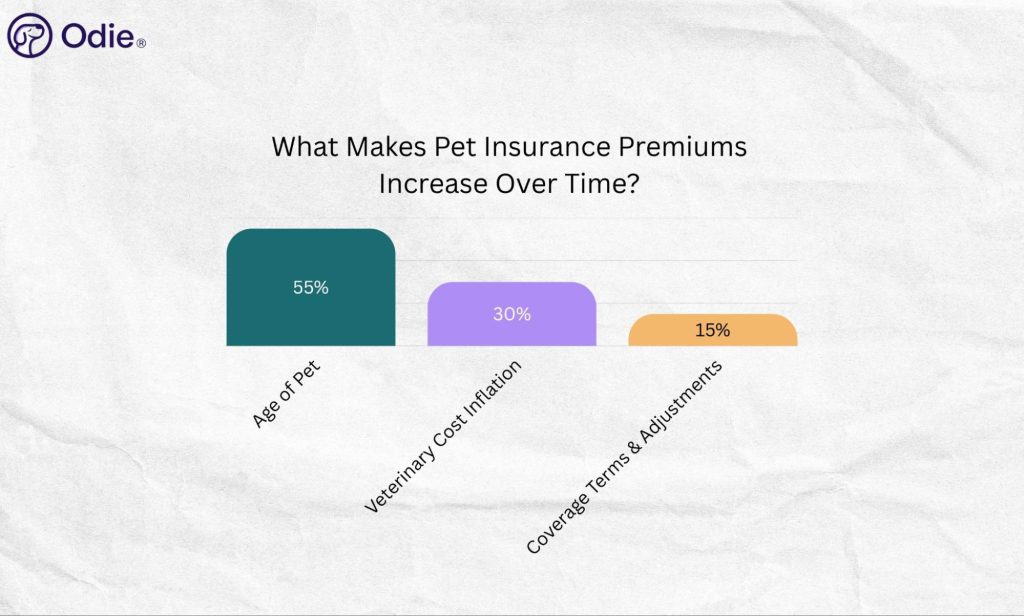
Pet insurance premiums are not static. Most plans adjust premiums at renewal based on a combination of the pet’s increasing age, changes in regional veterinary cost trends, and the insurer’s own claims experience in the prior period. Understanding what drives those increases allows owners to plan for them rather than being surprised at renewal.
Age-Related Increases
The most predictable source of premium increases is the pet’s advancing age. As covered in the previous section, older animals carry higher statistical risk, and premiums adjust to reflect that at each renewal. This is a built-in feature of pet insurance pricing rather than a discretionary insurer decision, and it applies across most providers in the market.
Veterinary Cost Inflation
Veterinary costs have increased steadily in recent years, driven by advances in diagnostic technology, specialist availability, and the increasing range of treatments available for pets. When the average cost of covered procedures rises in a region, insurers adjust premiums to maintain the ratio between premiums collected and claims paid. This inflation-driven component of premium increases applies even for pets whose own health has not changed.
Claim History and Risk Adjustment
Some insurers adjust individual premiums based on claim activity during the prior policy year, while others set rates based on actuarial data for the breed and age cohort rather than individual claim history. Reviewing the renewal terms and understanding whether individual claims affect future pricing is worth doing before a policy renews each year.
What Owners Can Do
- Review the renewal terms each year and confirm that the coverage level still reflects the pet’s current needs and the household’s budget.
- Adjusting the deductible upward at renewal is the most direct way to reduce a premium that has increased significantly, though it increases out-of-pocket exposure per claim.
- Comparing quotes from other providers at renewal is reasonable, but be aware that switching insurers means any conditions that developed during the prior policy period will be classified as pre-existing under the new policy.
Accident-Only Plans: A Limited Option for Specific Situations
Accident-only pet insurance covers veterinary costs resulting from unexpected injuries, such as fractures, lacerations, ingested foreign objects, and bite wounds, but does not cover illness, chronic conditions, or any form of preventive or routine care. These plans carry a lower monthly premium than accident-and-illness plans, reflecting their more limited scope.
At Odie, accident-only plans are available in specific circumstances. Owners whose pets have been diagnosed with one of seven qualifying critical illnesses may access accident-only coverage as an option for managing injury-related costs while the primary illness falls outside the plan scope. This structure means accident-only coverage is not a broadly available entry-level option but rather a specific pathway for pets whose health situation makes comprehensive coverage unavailable or impractical.
For most pets without a prior critical illness diagnosis, an accident-and-illness plan provides significantly broader protection at a cost difference that is often modest relative to the additional coverage provided. Accident-only plans are worth considering in the specific situations where they apply, but they are not a substitute for comprehensive coverage for owners whose pets qualify for it.
Adding a Wellness Plan for Complete Protection
A standard accident-and-illness plan covers unexpected costs. It does not cover the predictable, routine costs of keeping a pet healthy: annual wellness exams, core vaccinations, flea and tick prevention, heartworm testing, and dental cleanings. These are real and recurring expenses that add up over the course of a year, and a Wellness Plan add-on is designed to help offset them through a defined reimbursement structure for covered preventive services.
A Wellness Plan pairs with an accident-and-illness base plan rather than replacing it. Together, the two components cover both the unexpected events that create the largest single bills and the routine costs that accumulate steadily throughout the year. For owners who want the most complete financial picture of what pet care actually costs, the combination of an accident-and-illness plan with a Wellness Plan provides that coverage in one structured package.
- Annual wellness exams: reimbursed up to the plan’s specified limit per visit
- Core vaccinations: covered up to the annual allowance defined in the wellness schedule
- Flea, tick, and heartworm prevention: reimbursed as a preventive care benefit
- Dental cleanings: covered up to the wellness plan limit, subject to terms
- Additional screenings and diagnostics included in routine wellness visits, depending on plan tier
| Pair an accident-and-illness plan with a Wellness Plan for complete coverage of both unexpected and routine pet care costs. |
How to Get an Accurate Quote for Your Pet
The ranges in this article reflect typical market premiums for the variables described. The most accurate number for any specific pet requires a quote based on that pet’s actual breed, age, and zip code, combined with the coverage terms the owner selects. Two pets of the same breed can carry different premiums based on age alone, and two pets of the same age can carry different premiums based on location alone.
Getting a quote from Odie takes under two minutes and generates a real premium based on the pet’s specific profile rather than a range estimate. The quote process also allows owners to adjust the deductible, reimbursement percentage, and annual limit in real time to see how those changes affect the monthly premium, which is the most direct way to find the right balance between cost and coverage.
- Have the pet’s breed, date of birth or approximate age, and zip code available before starting the quote process.
- Start with the default coverage terms and then adjust variables to see how they affect the premium. Most owners find that modest deductible adjustments produce meaningful premium reductions.
- Consider adding a Wellness Plan during the quote process to see the combined cost of full coverage alongside the breakdown of routine care reimbursements included.
Frequently Asked Questions
How much does pet insurance cost per month on average in 2026?
The average monthly premium for a dog on an accident-and-illness plan is approximately $44 per month, based on NAPHIA industry data. Cats average around $29 per month. These figures represent the national average across breeds, ages, and locations. Individual premiums vary significantly based on the pet’s specific profile and the coverage terms selected, with dog premiums ranging from roughly $25 to $70 per month and cat premiums ranging from $15 to $40 per month.
Which dog breed has the highest pet insurance premiums?
Brachycephalic breeds with documented high-cost health conditions tend to carry the highest premiums. English Bulldogs and Great Danes consistently appear at the upper end of the premium range, with average monthly costs of $60 to $100 per month for comprehensive accident-and-illness coverage. French Bulldogs, Bernese Mountain Dogs, and Boxers also carry elevated premiums relative to the average due to their breed-specific health risk profiles.
Does pet insurance get more expensive as my pet gets older?
Yes. Premiums increase with age at most renewal periods because older pets carry higher statistical likelihood of illness and injury claims. The increase is gradual in earlier years and becomes more pronounced as pets enter senior classification, typically around age seven for dogs. Enrolling a pet at a young age locks in the lowest available premium and provides the widest coverage window before any conditions develop that might be classified as pre-existing under a new policy.
Why is pet insurance more expensive in California than in other states?
Pet insurance premiums are tied to local veterinary costs, which vary significantly by region. California has some of the highest veterinary costs in the country, driven by elevated real estate, labor, and operating costs for veterinary practices in the state. Because insurers set premiums to reflect expected claim costs in the owner’s region, owners in California and other high-cost states pay more for the same coverage than owners in states with lower average veterinary costs.
What is a Wellness Plan and is it worth adding?
A Wellness Plan is an add-on to a standard accident-and-illness policy that reimburses routine and preventive care costs, including annual wellness exams, vaccinations, parasite prevention, and dental cleanings. These are predictable, recurring expenses that a standard accident-and-illness plan does not cover. For owners who want a single structure that addresses both unexpected veterinary costs and routine care costs, adding a Wellness Plan provides that complete coverage. Whether it is worth the additional monthly cost depends on the household’s routine care spending and how much of that spending the wellness reimbursements offset.
Can I get pet insurance for an older pet, and will it be worth it?
Most insurers offer coverage for older pets, though the premium will be higher than for a younger animal and the policy will exclude any conditions that existed before the effective date. For a senior pet in good overall health with no significant prior diagnoses, an accident-and-illness plan can still provide meaningful financial protection for the unexpected events that become more likely with age, including cancer diagnosis, organ disease, and orthopedic conditions. The value calculation depends on the specific pet’s health status and the owner’s tolerance for out-of-pocket risk. A quote based on the pet’s actual age and profile is the most useful starting point for that assessment.
Conclusion
Pet insurance cost in 2026 is determined primarily by five factors: species, breed, age at enrollment, location, and the coverage terms selected. The ranges in this article, $25 to $70 per month for dogs and $15 to $40 per month for cats, reflect the spread across those variables rather than a single national figure that applies to every pet. The most accurate premium estimate for any specific animal comes from a personalized quote that reflects its actual profile.
For owners evaluating whether the cost is justified, the relevant comparison is not the monthly premium alone but the premium relative to the veterinary costs it would offset when a claim occurs. A dog that develops cancer, requires orthopedic surgery, or is diagnosed with a chronic condition can generate annual veterinary costs well into the thousands of dollars. An accident-and-illness plan at $40 to $60 per month covers a significant portion of those costs, and adding a Wellness Plan extends that protection to the routine care spending that accumulates each year as well.