
Active Dog Month: Simple Ways to a Fitter Dog
Active Dog Month falls in April, but the habits it encourages work year-round. Most dogs in the United States do not get enough daily movement. Estimates from veterinary researchers suggest that roughly half of American dogs are overweight or obese, a number that has climbed steadily over the past two decades. The health consequences range from joint stress and reduced mobility to a shortened lifespan.
The good news is that fitness improvements for dogs do not require a complete schedule overhaul. Small, consistent additions to a dog’s daily routine produce real results over time. An extra ten minutes of walking, a few minutes of backyard play, swapping a sedentary evening for a short training session, these accumulate in ways that show up in your dog’s body condition, energy, and mood.
This guide covers practical, accessible approaches to building a fitter dog, organized by activity type, lifestyle, and the specific needs of different ages and sizes, so you can find what works for you and your dog.
In This Article
- Why Active Dog Month Matters
- How Much Exercise Does Your Dog Actually Need?
- Simple Daily Habits That Add Up
- Low-Impact Options for Older and Less Mobile Dogs
- Mental Exercise Counts Too
- Active Play Ideas for the Backyard and Home
- Getting Active With Your Dog as a Team
- Weight and Fitness: Understanding the Connection
- Building a Routine That Sticks
- Signs Your Dog Is Getting Enough Activity
Why Active Dog Month Matters
April’s Active Dog Month started as a simple campaign to get dog owners thinking about their pet’s physical health, but the data behind it reflects a real pattern. Dogs with regular, appropriate exercise live longer on average, maintain healthier body weight, show lower rates of arthritis progression, and experience fewer behavioral issues rooted in boredom and excess energy.
The campaign also serves as a useful reset point for owners whose routines have drifted. Winter months often reduce outdoor activity for both dogs and owners. Shorter days, cold weather, and the gravitational pull of the couch can quietly erode what was once a solid walking routine. Active Dog Month in April coincides with longer days and improving weather in most parts of the country, a natural moment to rebuild.
The most practical takeaway from Active Dog Month is not any single activity but the mindset it encourages: fitness for dogs is a daily maintenance practice, not a project you do once when you notice a problem. Starting with small, repeatable additions is more effective than ambitious plans that last a week.
How Much Exercise Does Your Dog Actually Need?
The honest answer is that it depends significantly on your dog’s breed, age, size, and current condition. General guidelines exist for a reason, but they are starting points, not prescriptions.
By Breed Group
Working and herding breeds, Border Collies, Australian Shepherds, Siberian Huskies, Vizslas, and Weimaraners, were selected over generations for sustained, high-output physical work. These dogs typically need 90 minutes to two hours of meaningful activity daily to remain physically and behaviorally balanced. A 20-minute walk does not meet their needs.
Sporting breeds, Labrador Retrievers, Golden Retrievers, Spaniels, and Setters fall in a broad middle range. Most do well with 60 to 90 minutes of daily exercise spread across a couple of outings. They enjoy varied activities and adapt well to both running and slower neighborhood walks.
Toy and companion breeds, Shih Tzus, Maltese, Cavalier King Charles Spaniels, and Chihuahuas, have lower exercise requirements but still benefit from 20 to 30 minutes of daily movement. Short legs cover less ground per stride, and urban walks often provide adequate stimulation for these dogs without requiring long distances.
Brachycephalic breeds, French Bulldogs, English Bulldogs, Pugs, and Boston Terriers need special consideration. Their shortened airways make sustained aerobic activity more taxing, and heat compounds the risk. Shorter, more frequent outings in cooler parts of the day are preferable to long walks in warm conditions.
By Age
Puppies need exercise, but should not be pushed toward distance or duration before their growth plates close. A commonly used guideline is five minutes of structured exercise per month of age, twice daily, so a four-month-old puppy can handle roughly 20 minutes of structured walking per session. Free play in a safe space is less controlled but generally self-regulating, as puppies stop when they tire.
Adult dogs in good health follow the breed-based guidelines above. Senior dogs benefit from continued daily movement, but often do better with shorter, more frequent sessions rather than one long outing. Reduced intensity on hard surfaces, attention to signs of fatigue, and awareness of arthritis symptoms help calibrate exercise appropriately as dogs age.
Simple Daily Habits That Add Up
The most sustainable fitness improvements for dogs come from stacking small habits consistently rather than overhauling the routine all at once. Most of these require no equipment, no special location, and no more than a few extra minutes per day.
Add 10 Minutes to an Existing Walk
If your dog already gets a morning or evening walk, extending it by 10 minutes adds roughly 70 minutes of additional weekly movement without changing the schedule. Over a month, that is nearly five extra hours of activity. The dog does not know the walk has been extended; they experience it as a slightly longer version of something they already enjoy.
Change the Route
A new walking route introduces novel smells, sounds, and visual stimuli that engage your dog’s brain as well as their body. Dogs process the world primarily through scent, and a route with different trees, grass, and foot traffic is a genuinely enriched experience compared to the same path walked daily. Route variation does not add time but substantially increases the quality of the walk.
Practice Stops-and-Sniffs
Allowing your dog to stop and smell during walks, rather than maintaining a brisk pace, gives them more of what they actually want from a walk. Sniffing is mentally tiring in a way that sustained walking is not, and research on dog behavior suggests that dogs show lower stress indicators after sniff-focused walks than after physically longer but less exploratory ones. Slowing down to let your dog work a scent is not wasting time; it is doing the walk better.
Use Mealtimes as Training Time
Rather than placing a food bowl down and walking away, use a portion of your dog’s daily meal for a short training session. Five minutes of sit, stay, recall, and directional work burns mental energy, reinforces your bond, and keeps existing skills sharp. The dog gets the same number of calories, but in a form that requires engagement. This is particularly effective for high-energy breeds who need more mental stimulation than their outdoor time provides.
Low-Impact Options for Older and Less Mobile Dogs
Older dogs, dogs recovering from injury, and dogs managing orthopedic conditions like arthritis or hip dysplasia still need regular movement, but the type and intensity of exercise matter more than they do for younger, healthier animals. Stopping exercise entirely when a dog slows down is rarely the right answer. Continued gentle movement helps maintain muscle mass, joint flexibility, and circulation.
Swimming
Swimming is one of the best exercise options for dogs with joint concerns because it provides full-body cardiovascular work with no impact on joints. Water resistance builds and maintains muscle without the ground-strike stress of running or jumping. Many dogs take to swimming naturally, and hydrotherapy pools designed for dogs are available in many areas for dogs who need structured, supervised aquatic exercise.
For dogs new to swimming, shallow entry is important. A dog lake or calm creek where they can wade in gradually is preferable to jumping from a dock. Life jackets designed for dogs provide additional safety for inexperienced swimmers and are worth using for any dog in open water.
Short, Frequent Walks
For a senior dog who struggles with 40-minute walks, three 12-minute walks spread through the day often provide more cumulative benefit with less fatigue and joint stress than one long outing. The pace should be comfortable for the dog, following their lead on speed and stopping when they show signs of tiring. Grass and soft surfaces are easier on older joints than concrete.
Gentle Stretching and Passive Range of Motion
Passive range-of-motion exercises, gently moving a dog’s limbs through their natural movement arc, can be done at home and help maintain joint flexibility between walks. Your veterinarian or a canine rehabilitation therapist can demonstrate the appropriate movements for your dog’s specific condition. These exercises are particularly useful for dogs recovering from surgery or managing diagnosed arthritis.

Mental Exercise Counts Too
Physical exercise gets most of the attention in dog fitness conversations, but mental stimulation burns energy in ways that are just as real and sometimes more efficient. A dog who is mentally tired is behaviorally settled in a way that physical fatigue alone does not always produce.
Puzzle Feeders and Snuffle Mats
Puzzle feeders require a dog to manipulate levers, slide compartments, or work out a sequence of steps to access their food. The same portion of kibble that takes 30 seconds to eat from a bowl can occupy a dog for 10 to 20 minutes in a puzzle feeder. Snuffle mats, textured fabric mats that hide kibble pieces in fibers, work on the same principle, engaging the nose and slowing the eating process. Both are inexpensive, easy to clean, and usable daily.
Nose Work and Scent Games
Teaching a dog to find a specific scent hidden in a room or yard is a structured activity with genuine physical and mental engagement. Competitive nose work is a growing dog sport, but the foundational skills, teaching a dog to find a particular smell and indicate its location, are accessible at home with no formal training background required. A dog searching a room for a hidden treat is working hard, even if they look relaxed.
Training New Skills
Learning a new behavior requires focus, body awareness, and sustained concentration. Teaching a dog to back up, spin, weave between your legs, or retrieve a named object introduces new neural pathways and gives the dog something to accomplish. Short training sessions of five to ten minutes are more effective than long ones, dogs retain information better with regular short exposure than with infrequent extended sessions.
Active Play Ideas for the Backyard and Home
Not every fitness activity requires leaving the house or the yard. For dogs with outdoor space, structured play sessions at home can provide meaningful exercise without a commute.
Fetch Variations
Standard fetch is one of the most efficient ways to exercise a dog; they cover significant ground while you cover very little. Varying the game keeps engagement high: rolling the ball along the ground rather than throwing it changes the chase pattern and is gentler on shoulder joints than repeated high jumps. Hiding the ball and asking the dog to find it introduces a nose-work component. Using two balls allows you to throw the second one before the dog returns the first, maintaining momentum without teaching possessive holding.
Flirt Pole
A flirt pole is a long, flexible pole with a lure attached by a rope, similar in concept to a cat wand toy. The dog chases the lure as you drag and swing it in unpredictable patterns. A few minutes of flirt pole work provides high-intensity cardiovascular exercise with low risk of overheating from sustained running. It is particularly effective for high-prey-drive dogs who find fetch uninteresting. Always end the session by letting the dog catch and hold the lure; this provides a satisfying conclusion and reinforces appropriate impulse control.
Tug
Tug is a safe, physically engaging game when played with clear rules. The dog should drop the tug on a cue word before the game continues. This teaches impulse control alongside providing a workout. Tug builds shoulder and neck muscle, elevates heart rate quickly, and most dogs find it highly motivating. It is not a dominance-signaling behavior; research on dog play has consistently found that tug does not produce aggression when played with consistent rules.
Indoor Stairwork
For dogs who live in multi-story homes, a few repetitions of guided stair climbing at the dog’s own pace adds low-intensity hind-end strength work to the day. This is not appropriate for dogs with confirmed hip or spinal issues without veterinary guidance, but for healthy adults and younger dogs, it is a simple way to add movement without going outside.
Getting Active With Your Dog as a Team
Some of the most effective dog fitness habits are built around activities that benefit the owner as much as the dog. When the human also gets something from the exercise, the habit is far more likely to be sustained.
Running and Jogging
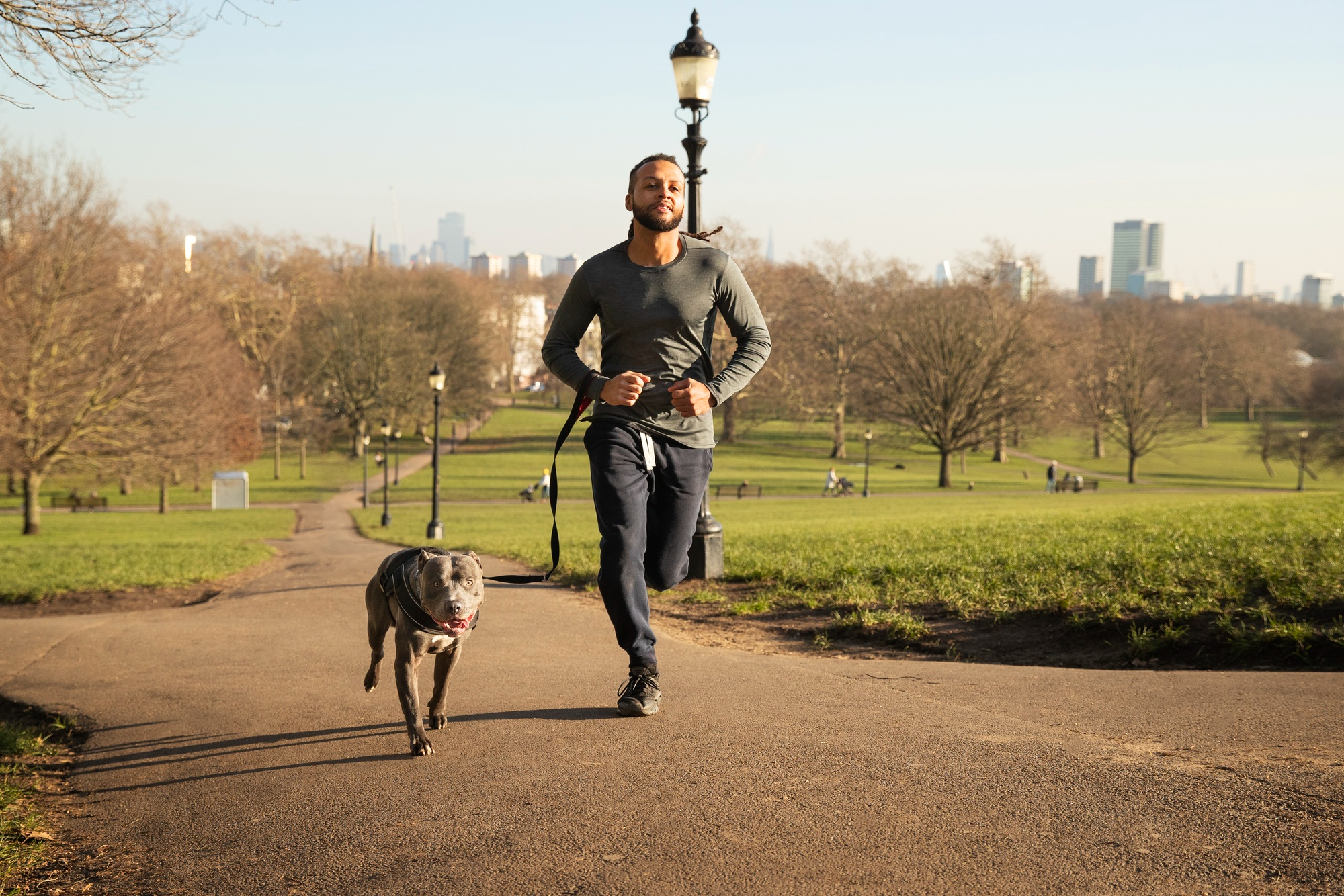
Running with your dog is a highly efficient activity for both parties. Most medium and large dogs make good running partners once they have basic leash manners and have been gradually conditioned to the distance, starting with run-walk intervals rather than jumping to a full run. A hands-free running leash attached to a waist belt makes the experience more comfortable for both. Avoid running on hot pavement, which can burn paw pads; early morning runs in summer are preferable to midday.
Hiking
Trail hiking offers varied terrain, new smells, and longer, sustained exercise that most neighborhood walks do not provide. Even a 45-minute local nature trail introduces a dog to mud, leaves, water crossings, and varied elevations, engaging them differently than urban routes do. Check trail dog policies before going, keep the dog on a leash in areas with wildlife, and bring enough water for both of you.
Dog Sports
Agility, flyball, dock diving, canine freestyle, and herding trials are organized sports that simultaneously build fitness, focus, and the dog-owner relationship. Most dog sports clubs welcome beginners and offer foundation classes that do not require any prior experience. The structure of a weekly class creates accountability in a way that solo walking sometimes lacks, and the community of other dog owners is often an added benefit that keeps participation going.
Weight and Fitness: Understanding the Connection
Exercise and weight management work together but are not interchangeable. A dog cannot reliably exercise their way out of a consistent caloric surplus, and a dog on a well-calibrated diet will see fitness gains from relatively modest activity increases. Understanding the relationship between the two helps set realistic expectations.
Body condition scoring is the most practical tool for assessing whether your dog is at a healthy weight. A dog at an ideal weight has ribs that are easily felt with light pressure but not visibly prominent from across the room. A visible waist tuck when viewed from above and an abdominal tuck when viewed from the side are also indicators of healthy body composition. Your veterinarian can demonstrate the scoring system during a wellness visit and provide a benchmark for your specific dog.
If your dog is overweight, the combination of modest caloric reduction and consistent daily activity produces more reliable results than either alone. Reducing treats, switching to lower-calorie treats, or feeding measured portions rather than estimating are often sufficient dietary adjustments alongside a walking increase.
For dogs significantly overweight, low-impact exercise like swimming or slow leash walking is preferable to high-impact activity that stresses already-loaded joints. Weight loss in these dogs is a gradual process measured in weeks and months, not days, and that is the appropriate pace for sustainable change.
Building a Routine That Sticks
Most fitness plans for dogs fail the same way human fitness plans do: they start with too much ambition, produce fatigue or logistical friction, and quietly drop off after a few weeks. The habits that persist are the ones that fit naturally into the existing daily structure.
Attaching a new dog activity to something you already do reliably is the most effective approach. If you make coffee every morning, that is the cue for a 15-minute walk before work. If you watch television in the evening, the first commercial break is the cue for five minutes of training in the living room. The activity does not need to be long; it needs to be consistent enough to become automatic.
Tracking is optional but useful for accountability. Noting the duration of daily walks, even informally in a phone note, makes it visible when a week has gone by with shorter-than-intended activity. Several apps designed for dog owners log walk routes, duration, and weight trends over time, which can be useful for conversations with your veterinarian about your dog’s progress.
Starting Active Dog Month with one new habit is more likely to succeed than starting with five. Adding a 10-minute extension to one daily walk is achievable by almost any dog owner. From that foundation, a second habit is easier to add the following month.
Signs Your Dog Is Getting Enough Activity
A well-exercised dog tends to show a consistent set of indicators that are easy to observe over time. These are not guarantees; individual dogs vary, but they are useful reference points for assessing whether your current routine is meeting your dog’s needs.
Signs of Good Activity Level
- Settles calmly after exercise without pacing or restlessness
- Sleeps through the night without excessive waking or disruption
- Maintains a healthy body weight without significant dietary restriction
- Shows appropriate interest in walks and play without obsessive or frantic behavior
- Recovers from exercise within 10 to 20 minutes, breathing and heart rate return to normal
Signs That More Activity May Be Needed
- Destructive behavior at home, particularly during the day or evening
- Excessive barking, whining, or attention-seeking behavior
- Inability to settle in the house even after a walk
- Weight gain without dietary changes
- Restlessness at night or difficulty sleeping
These behavioral signs are common in dogs who are physically or mentally understimulated. They are also seen in dogs with other conditions, pain, anxiety, or medical issues, so a veterinary conversation is worth having if behavioral changes appear suddenly or alongside other symptoms.
The Bottom Line
Active Dog Month is a good prompt, but the habits it encourages are year-round ones. A fitter dog is not the result of one ambitious month of activity, it is the result of small, consistent additions to a daily routine that compound over time into better body condition, better behavior, and a longer, more comfortable life.
Start with what is achievable. Add 10 minutes to a walk, introduce a puzzle feeder at dinnertime, try a new route on the weekend. Each of those is a real improvement that requires almost nothing from your schedule and provides something concrete to your dog’s health and quality of life.
The best exercise plan for your dog is one that fits your actual life and gets done consistently. An imperfect routine maintained over months is worth far more than a perfect routine that lasts two weeks.